Showing posts with label Side Dishes - Vegetable Dry curries. Show all posts

Sunday, February 11, 2018

Vankayai allam koora - a koora (side dish) that brings home the freshness of earth

Just when I was losing faith in the Groundhogs' abilities to predict weather accurately, they returned with a bang on Feb 2nd and declared we were going to have winter for another 6 weeks. How would you contest such accurate prediction :-)? What would we do without these lovable creatures? Though that wasn't the greatest of news, I admire their accuracy, they are way better than most of our weathermen in TV channels. Now that they are done with their one important task of the year (is there anything else they do other than hibernating and popping up once a year?) and met expectations (don't you think the bar is pretty low here!!) and returned underground to continue whatever they were doing, I am left here to stay warm and wait patiently for the onset of warm weather. Don't get me wrong, I am not complaining about winter but I don't mind seeing the mercury go a little higher on the scale. Whether it is Spring yet or not, I am itching to bring Spring into my kitchen. Today's recipe is one such that brings that whiff of Spring and freshness with ginger.
Spring is somehow wired in my brain as the same as clean, fresh and crisp air and flavors. While there are many herbs and spices that make this happen in the kitchen, ginger definitely tops the list. Combined with the sharpness from green chilies, this masala really elevates fresh vegetables. No powdered spices in this koora, just some tender eggplants sauteed with freshly crushed ginger and chilies and seasoned with a few crunchy dals and mustard, simple enough? This koora works perfectly with rotis or rice.

My advice is to use fresh ginger, take them to a mortar & pestle or another device that lets you crush it. The flavors of ground ginger Vs grated ginger Vs crushed ginger is very different and this recipe definitely loves the crushed version. If you were thinking of using that store bought (or even home made a couple of weeks ago and refrigerated) ginger-green chili paste, please do not do it. There is nothing complicated about this recipe so spend a little time on using freshly crushed ginger.
I have written many posts about eggplant recipes and have also talked about my late blooming love for them. If you are in the mood for reading my eggplant musings just hit the search button and look up other eggplant recipes. My family (except for DD) is of the group where they will give anything for a well made eggplant dish and do not complain if this humble vegetable made its way to their plates every day :-). So our eggplant recipe repertoire is pretty vast as you can probably imagine.

This is a heirloom recipe that is found commonly in most East Godavari Telugu homes. Crushed ginger and green chilies make a really fresh tasting dishes. I add curry leaves because they are one of my favorite flavoring agents in the kitchen. You can replace eggplants with potatoes, and then who doesn't love the spuds?
When I prepared this koora for the first time on my own, I went and looked for the smallest green brinjals thinking that they would be the tenderest ones and hence tastiest too. BH remarked that it had to have some seeds and not be really tiny. He is the expert and I accept my mistakes generously. So the next time I brought home slightly bigger ones and the koora was definitely tastier. So here is my tip to all of you newbies. The tiny ones are picked before they can develop any flavor and they also shed jackets (or skin) as they cook which is not a great experience while eating. The medium sized ones (about a big lime) are the best suited for this koora as they give a meaty texture to it. Pick eggplants that look fresh, are green without any black spots or tiny holes on the skin.

If you noticed, I used both terms - brinjal & eggplant, in Indian cooking there is no difference between the two as they belong to the same general family :-). Local languages distinguish each variety by size and color as pedda vankaya (big eggplant), tella vankaya (the green ones with white interfaces used in this recipe), nalla vankaya or gutti vankaya (usually the small, round purple). I hope the pictures in the post help.
NOTE: Pictures are from 2 different days, the lighter colored one does not have turmeric powder (I do forget sometimes :-)) and also has a Tbsp grated coconut added to it. The original recipe does not have coconut and the dish really doesn't need coconut, but some of you regular readers here already know about my weakness with coconut :-)
What do you need to make vankaya koora? 
8-10 small green brinjal/eggplants
1.5 inch fresh ginger
3-4 green chilies (adjust to your spice tolerance)
6-8 tender curry leaves
2 Tbsp oil
1 tsp salt
1/4 tsp turmeric powder
Seasoning: 
1 Tsp oil
1/2 Tsp mustard
1/2 Tsp chana dal
1/2 Tsp urad dal
1-2 pieces of dry red chilies (optional)
1/8 Tsp asafoetida/hing
How do you make vankaya koora? 
  • Wash the eggplants, remove the stalk end and chop into cubes (really tiny ones are just made into half, medium sized ones chopped into quarters)
  • Immediately immerse chopped eggplants into a fresh bowl of water. 
  • Heat a wide pan and add 2Tbsp of oil. 
  • Strain the water and separate the eggplant pieces. 
  • Add the eggplant into the hot oil and stir once so the pieces get coated with oil. 
  • Reduce the heat to medium, add salt and turmeric powder, mix once.
  • Cover and cook for 5-6 mins on low heat or until the pieces become fork tender.
  • Wash, peel and cut ginger into small pieces.
  • Take ginger pieces, roughly torn curry leaves and green chilies to a mortar & pestle and crush them into a coarse paste. 
  • Once the eggplants are tender, add the ginger-chili paste and give it a good mix. 
  • Cover and continue to cook for 2 mins until the flavors mingle well. 
  • Switch off and transfer to a serving bowl. 
  • Heat the oil for seasoning, add mustard, dals, red chilies (if using) and asafoetida. 
  • Let mustard pop and dals turn light pink. 
  • Switch off and pour the seasoning over the koora. 
  • I prefer to mix the seasoning just before serving as they retain the crunch. 
Notes: 
  • Select tender and bright green eggplants. The ideal size is typically a big lime size. 
  • Crush the ginger- chili fresh, do not use stored paste for this recipe. 
  • We like the ginger flavor, play with the amount of ginger and green chilies you want to use in this recipe as spice tolerances vary.

Sunday, February 26, 2017

Phodi - A desi version of Italian eggplant parmesan (no parmesan though) :-)

It has been a long time since I shared the books on my night stand and the movies I watched, I thought of doing this as part of today's post especially because I am back to reading this new year and also have been watching movies fairly regularly. And timing can't be better with Oscars 2017 just a few hours away, right?. Well, I was writing the draft of the post (as you can imagine) earlier this afternoon and got to posting the final version only now (after watching the Oscars) :-). Did you watch it? Any favorites? I have only seen 'Arrival' so far this year, the others 'Hidden Figures', 'Moonlight', 'La La Land' and ofcourse 'Fences' are on the list, will get to them slowly, may be on the tube if not in theaters. But I am glad to be back to reading books at my old pace. Two of the things that make me really happy in this life - a pile of good books and a pantry full of raw materials. Books to help me in and out of any situation and pantry grounds me to the current moment, focus on the basics. I currently have a bagful of books on my nightstand and two of them are by the same author recommended by a friend. I also recently watched a wonderful movie on the recommendation of another friend. Both suggestions were spot on and I loved both the books and the movie :-).
A dear friend who is also a published author recommended William Trevor to me recently. I am always partial to short stories, I feel like a well written short story has the potential to make a greater impression in a few short pages than a long, elaborate novel. While novels provide a wide space and a broad brush to slowly and deliberately introduce characters, build the story line and express emotions, short stories do not offer any of this luxury but infact demand that the writer be totally convinced about what (s)he is trying to convey in the tight space. Only a very able writer can do justice to paint a lingering image within a span of a few pages of his/her writing. A well written short story can be very powerful while a badly written one can fall flat on its face. William Trevor makes reading short stories a pleasure and I am hooked into his style of writing and the characters he brings to life with his narration. Having finished both 'A bit on the side' and 'Cheating at Canasta', I am on a waiting list for his 'Collected Short stories' next :-). Thanks J for the recommendation, not sure how I never got to his books earlier.

Another friend S mentioned Helen Mirren's "Woman in Gold" on Netflix to me. With HM in the lead I didn't need additional push in the direction and watched it last weekend when I was home alone while BH was busy at some conference. Based on a true story, the movie deals with the recovery of a piece of art with a very intimate personal connection. As any work with the Nazi Germany, this movie has the power to put a knot in your stomach but I enjoyed watching the movie. It is still on Netflix and definitely a watch worth its time. Again, thank you S for the lovely chat and the movie reco :-)

Do you have books or movie recommendations? Something that you enjoyed spending time with? Share them in the comments.
Moving on to the recipe today, here is a deceptively simple and delicious snack, appetizer, side dish made with eggplants. Depending on your mood, you can serve this as a starter or main course. I first tasted this a decade+ back at one of BH's colleague's home when we went there for dinner. His parents were visiting and as R & wife had two young kids that demanded the parents's time and attention, aunty had taken charge of the kitchen. They are originally from Gokarna, the beautiful northern karnataka temple town and aunty's food was everything I had read and imagined from that region. The ease and skill with which she rolled out soft akki rottis and served them hot off the griddle for the ten of us while making it all look so effortless is something I can never forget. I most definitely remember calling nammamma that night and telling her all about aunty's cooking :-). After all these years, I don't exactly remember the entire spread (it certainly was a spread) but one dish that became an instant hit with us was this 'phodi'. She had made them with eggplants and potatoes and kept them ready even before we reached their home and served it along side the akki rottis for dinner. Yumm!!
Eggplants and I have a long history, it started with me completely hating the vegetable and staying miles away from it to decidedly ignoring it when it made its way to my plate to falling in love with nammamma's vangibhaath to enjoying the delicious gojju to totally changing sides with amma's stuffed vankaya. I am sure many of you can relate with this, it is not a vegetable that has universal appeal of the spuds but everyone in my family with the exception of DD loves this simple, nutritious and healthy vegetable. The only way DD eats this vegetable currently is in the form of this phodi and sometimes the stuffed version. I exploit that shamelessly and make this often so she gets to eat the vegetable and hope that someday she will be a convert just like her own mom :-). BH on the other hand can eat this phodi all by itself and call it a meal, such is his love for the humble eggplant.

Being an ardent Olive garden fan, DD called this Indian eggplant parmesan since it resembles the Italian dish in looks :-) but the name is misleading as the ingredients and taste is very different as is the cooking method. If you love eggplants and like the texture of tenderized/shrivelled eggplants and are trying to skip cheese and Italian seasoning, this is a perfect dish. Go ahead and give it a try.
What do you need for Phodi? 
1 medium sized eggplant
3 Tbsp oil
Spice mix: 
3/4 cup upma rava/sooji
1 Tsp red chili powder
1 Tsp salt
1/2 Tsp coarse crushed black pepper
1/4 Tsp asafoetida
1/4 Tsp Turmeric powder
How do you make Phodi? 
  • Wash and pat dry the eggplant, cut both the stem end and the opposite end.
  • Cut the eggplant in discs of about 1/4 inch thickness and keep them immersed in a bowl of water to avoid discoloration.
  • Heat a heavy (preferably cast iron) griddle on medium heat and let it heat up (a sprinkle of water should immediately sizzle)
  • Take a wide plate, add all the ingredients listed under spice mix and mix them uniformly. 
  • Taste test a pinch and adjust salt, chili powder or black pepper to suit your taste.
  • Make sure the pan is hot, drizzle a couple of drops of oil and smear it all around the pan and reduce heat to low. 
  • Take an eggplant disc from water, shake away all the water and dredge it in the dry spice mixture to form a thick & even coating on both sides. 
  • Lay the eggplant disc on the hot griddle and repeat for as many pieces as your griddle can hold. 
  • Drizzle drops of oil on and around the eggplant discs, cover and cook for 2mins. 
  • I use a glass lid for this so I can see the progress of cooking from outside without having to lift it multiple times :-)
  • Once the top layer is moist and the disc looks a little shrivelled, gently lift each one and turn it over. 
  • Let it cook for another minute and half, add a drizzle of oil on top. Do not cover while cooking the second side. 
  • Take the discs off the griddle when both surfaces have reached your desired color and crispiness. 
  • These taste delicious hot off the griddle and equally yummy when they cool down making it an easy lunch box item or a make ahead item for a party. Just warm it up before serving. 
Notes: 
  • Eggplant tip: Select one that feels heavy for its size. Also look for seedless varieties of eggplants. Get one that is dark purple in color and is not squishy.  
  • You can use potato slices, sweet potatoes instead of eggplant
  • Cooking time varies with the heat and the thickness of the discs
  • Always cook this dish on low heat allowing the vegetable to cook thoroughly and not burn the outer surface. 
  • Covering while cooking ensures moisture is captured and the vegetable cooks in its own juices. 
  • It is important to keep the spice mix as dry as possible until you are done. Avoid water drops falling into it too much, if you are making a large batch, I suggest you take out handfuls of the mixture into a separate plate and replesnish as you need.  A wet mixture doesn't stick well on the vegetable. 
  • Do not skip asafoetida or turmeric as it brings a distinct flavor to the dish. 

Sunday, February 28, 2016

Spinach -Tamarind pachadi and some random chat about stereotypes

Spring has made its way surely and steadily. I don't want to jinx it but except for the big storm in Jan, winter overall has been kind to everyone and especially moderate to us. Our Camalias think it is totally safe for them to bloom and for their sake, I hope temperature just continues to rise up and not make a nose dive. Here is one gorgeous bloom from my front yard, just fills my day with happiness as I look at the entire plant come alive with these tender beauties all over. As far as my tropical plants in pots, I will wait another month and half before bringing them out to the deck. Hope everyone is enjoying the weather they have!
Buoyed by the beautiful surroundings, I made a more than the normal weekend lunch today. Here is how our lunch plates looked :-) and it was delicious. Before you get ideas, this is not the norm, just an exception. We are happy eating a one pot meal most weekends and in bowls without bothering to set a plate out. The fire roasted papad was a perfect cherry on top for the traditional lunch thali. 
Yesterday was one of those Saturdays when both BH & I didn't feel like going out. Talked to DD online for a while during the day when she had time and we both decided to stay home, warm and cozy infront of the big screen. As we were browsing for something that would keep both of us engaged, I happened to notice this movie called 'Dum Laga Ke Haisha' on Netflix. I am glad we ended up watching that movie. It reinforced the fact that many people have been thinking about how we stereo type and categorize everything in the world. For one, it was a very cute and refreshing movie and both the lead roles have delivered good performances. I am not a movie critic by any standards but thought the plot was definitely praise worthy especially in the times where we all seem to adore heroines that perfectly fit the stereotype and can slip into size 0 outfits effortlessly. I have nothing against slim or non-slim women but it enrages me to think that our movies have been misleading an entire generation of women to lose their self worth just because of how they look. 

Though the plus sized heroine is the focus in the movie, the story also deals well with the frustrations of the un(der)educated husband and the world surrounding them which includes a show off friend who happens to have a slim and beautiful wife, a lower middle class family and parents who go hunting for an educated daughter in law that will earn and bring supplemental income to the household. I am sure the movie could have been morose or taken a totally different tone for addressing the story but this one has a lively and funny treatment all through. And the best part is that the hero & heroine fall in love despite the fact she doesn't transform into a physically stunning goddess by the end of the movie and stays firm on her plus size :-). I thought it was well worth a watch and something to be proud of for breaking the stereotypes. I recommend the movie to all like minded people :-)
'Breaking of stereotypes' talk reminds me of another story making the rounds in facebook recently about an Indian designer finding her model in a house maid. I saw some pictures attached to the story and thought it was pretty impressive that she transformed a girl who was absolutely unaware of the fashion world into a confident model that sat and posed with her designer wear, pretty cool, ha? I don't know how things will turn out for this accidental model but wish both her and the designer a good future.

Ok, I know many of you come here to check out the tasty, mouth watering recipes and are not really as interested in my commentary about a movie I liked, so let me take you to today's recipe showcase. This has got nothing to do with breaking stereotypes by the way and I am here with a very traditional, age old recipe from South India that I was reminded of in my favorite cook book '660 curries'. He calls it 'puli itta keerai' due to his Tamilian background but this is also known as palak pachadi or palak chutney in other parts of South India. It is a totally no-fuss dish that not only adds color to your plate but a lot of nutrients and taste too.

One of my friends recently posted a picture of an omelette she made and said she had her quota of greens for the day because of the amount of cilantro she put in it :-), quite sneaky, right? I called it 'cheating'. If you are looking for a tasty recipe that also gets in a good load of the mighty spinach into your body, here is one for you. The slow roasted and ground urad dal adds a lot of flavor to the dish. Go ahead and try this recipe that uses the usual ingredients found in any staple Indian pantry.
I may watch a little bit of Oscars tonight, how about you? Any favorites? Talk to you again next week.

What do you need to make Palak tamarind pachadi? 
3 packed cups of roughly chopped spinach/palak leaves
2 Tbsp shredded coconut
1.5 Tbsp oil - divided use
1/2 Tsp salt (adjust to taste)
To roast: 
2 Tsp urad dal
1 Tsp chana dal
1/8 Tsp fenugreek seeds
2 green chilies
2 dry red chilies
2 1-inch pieces of tamarind
Seasoning: 
1/2 Tsp mustard
1/2 Tsp urad dal
pinch of asafoetida

How do you make Palak pachadi? 
  • Heat 1 Tbsp oil in a pan (use a big pan and you can reuse it to saute spinach leaves too).
  • Lower the heat to medium, add all the ingredients listed under 'To roast', chop or slit green chilies to avoid them popping out. 
  • Stirring frequently, roast the dals until they turn golden red and lose all their raw smell and taste, about 3 minutes.
  • Take out the dals onto a plate and let them cool. 
  • In the same pan (I told you to take a big one :-)), add the chopped spinach leaves and saute them for 3-5 minutes until the leaves wilt and become pulpy. 
  • Switch off and let cool. 
  • Take the roasted dals, chilies and shredded coconut in a blender, add salt and blend it to a coarse paste without any water. 
  • Once the ingredients come together but you can still feel the texture of dals, add the sauteed & cooled spinach to the blender and give a couple of quick pulses to bring everything together. Make sure you do not puree the mixture. 
  • Take it out into a bowl. 
  • Heat the remaining oil, add the ingredients listed under 'seasoning' and let mustard pop. 
  • Add the seasoning to the pachadi and give it a mix. 
  • Serve it with hot rice and a drop of ghee (or millet like I did) or with roti/chapati. 
Notes: 
  • Roasting the dals on a low flame is key to this recipe. Urad dal when not fried sufficiently tends to be sticky on grinding and also has a raw smell which is a no-no in a pachadi. So take time to roast them well. 
  • The pachadi is slightly chunky and spinach does not get pureed. 
  • Add chilies and tamarind to balance the blandness of spinach, the pachadi needs to be a little spicy and tangy for it to taste best. 
  • Don't add salt to the spinach while sauteeing, it increases the amount of water that comes from the greens, add it to the blender while blending. 
  • The sauteed spinach has enough moisture to make the chutney, do not add water to this.

Sunday, February 14, 2016

Hagalakayi (bitter gourd) palya - An unusual love affair

Happy Valentine's day everyone! Hope you all had a good celebration of the precious love in your lives and I hope it continues to get stronger through the rest of the year and life.

We had a good Sunday, got up late, cooked a storm in the kitchen and had a great brunch. Nothing typical of what you would expect on a Valentine's day lunch plate :-) but everything me & my valentine love in food was there. Other than that it was any normal Sunday.
Since the blogosphere is bursting with overdose of sugar for the Valentine's day, I thought I will step in and save the world from the risk of mass diabetes and deviate from the theme a wee (more than a wee) bit with my post. We were talking to parents in India on Friday and amma reminded me to make some payasa on Saturday as it was Ratha Saptami. Dutiful DIL that I am (and since we were both craving for something sweet and yummy :-)), I immediately followed up on it and made a delicious anna-payasa or rice kheer which after an hour on the stove became creamy and irresistible. I had every intention of making just a cup of it but with the rice and jaggery and milk, I ended up with substantial quantity that extended into Sunday too :-). Once cold in the fridge, it was so delicious. Thus our Valentine's day started with a ready to eat sweet item. And I didn't have to specially make anything sweet for the Valentine's day.

Somehow the concept of Valentine's day didn't grow on me, we used to make cards and cookies when DD was in grade school so she could take it to all her classmates and teachers but she outgrew that too. The innocence of bulk valentine day cards gave way to adolescent "yew, who gives cards and heart candies to boys" soon. Today I message her in the morning and wish Happy Valentine's day and she writes back a hurried 'Mwah, mwah". I am an insistent mom and ask her, "what is special for Valentine's day"? and get a "what Valentine's day? Mom, I have assignments upto my nose and am studying for my psych exam next week, stop being silly". I know some day it will change again :-) and I am not in any hurry for her to get there either. For me personally, celebrating love on a specific day feels restrictive, being in love is eternal, is a life long thing for me :-). Not that I don't appreciate flowers and gifts on the day but I prefer to take the pressure off of us of having to do something cute on this day to stay cool. More than anything else, it is also a great excuse for not having to come up with creative ideas to celebrate Feb 14th which suits the lazy me very well :-)
So on this Valentine's day I have a to make a confession of my our love to this vegetable. Not many people love it and it doesn't make the main stay in meals but I have openly talked about my feelings for this vegetable here, here, here, and here on the blog. If that is not sufficient proof of the intensity of this love affair, what is? We love to eat bitter gourd any form or shape though there are a few 'favoriter' recipes that have an edge over others. And then I keep adding to my repertoire of bitter gourd recipes as I come across them. Some make a mark and stay on and some just breeze in and out of my kitchen with a single occurrence. I first found this in a cookery book, the source mentioned it as a Gujarati dish, then I also saw it on an online Telugu cookery show. I combined the best of both worlds, made a few changes to suit my palate and viola, created a keeper recipe I have made multiple times.

The Gujarati version called it bitter gourd dry chutney and the Telugu version called Kaakarakaya chutney podi :-). Gujarati version was low on chili powder but added lot of crushed peanuts while the Telugu version skipped peanuts and poured red chili powder to the delight of a hard core spice lover. I chose to tread the middle path and combined ingredients from both. My version is not as dry as a spice powder and I don't think it fits a 'chutney' label, so I am kind of undecided on the category. I am ok calling it palya (stir fry) or subzi for now. No matter what you call it, it tastes delicious and if bitter gourd is one of your valentines (that is an overloaded statement right there, we will get back to that later :-)), give it a try and I am sure you will fall in love all over. The flavors are intense from the gourd, peanut powder and the sesame. Pair it with a mild yogurt based curry like majjige huli and enjoy.
Disclaimer: For those of you who are not bitter gourd fans, don't try to judge me for posting a recipe with this vegetable for Valentine's day, "har prem kahhani anoukhi hoti hai, jaroori nahin ki sub log use samjhe" (every love story is unique, not that others always understand it) :-). Each to his or her own taste.

What do you need to make bitter gourd palya? 
3 medium sized bitter gourd
1 Tbsp sesame seeds
1/4 Tsp tamarind paste
2 Tbsp oil
1/2 Tsp red chili powder
3/4 Tsp salt
2 Tbsp finely chopped onion
1 Tbsp peanut powder or coarsely crushed peanuts
1/2 Tsp mustard
2 green chilies - chopped
6-8 curry leaves - chopped
1 Tsp crushed jaggery/brown sugar
1 Tsp chopped cilantro
pinch of turmeric powder
1/8 Tsp asafoetida
How do you make bitter gourd palya? 
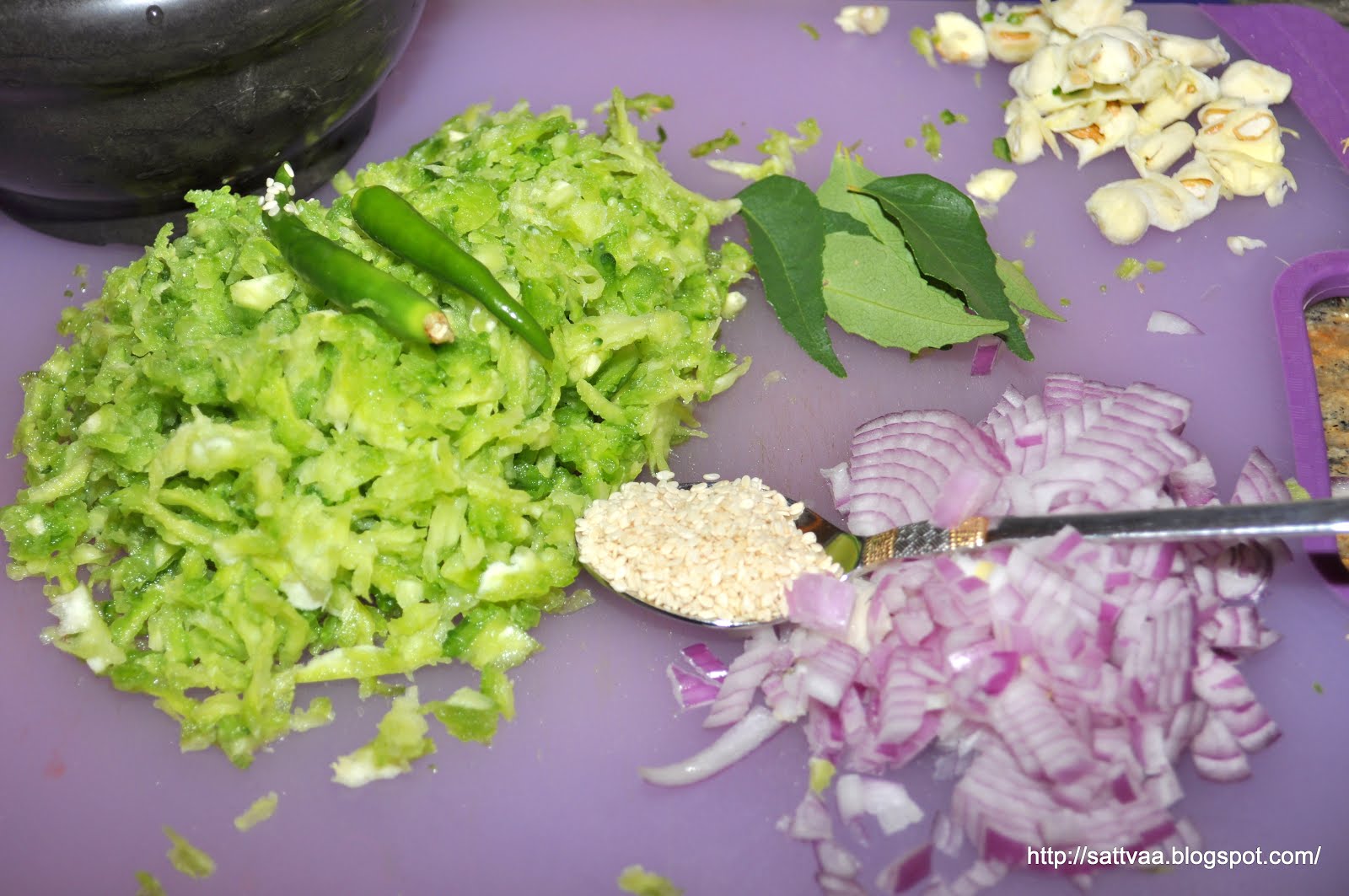
  • Wash, cut the ends and scrape the outer skin on bitter gourd lightly. 
  • Slit them vertically into halves and remove the seeds. 
  • Reserve about a Tbsp of tender seeds for later use and discard the remaining. 
  • Grate the bitter gourds on the big hole side of a grate or process them in a food processor or chop them finely. Idea is to get really tiny pieces without making a paste. 
  • If you want to reduce the bitterness, add a pinch of salt and turmeric to the grated gourd, set aside for about 20 minutes, squeeze out all the juice that is generated. Wash the bitter gourd under running water and squeeze out the vegetable. While this removes the bitterness, it also removes a lot of nutrients.
  • I like to retain the natural bitterness and go to the next step directly. 
  • Heat 1.5 tbsp oil in a pan, add mustard and let it pop. 
  • Add sesame seeds, chopped green chilies and curry leaves and let roast for 30 secs.
  • Chop up the tender seeds reserved and add them to the pan, let them roast for a minute. 
  • Add chopped onion followed by salt, asafoetida and turmeric powder and let the onion sweat and soften up. 
  • Add the tamarind paste and jaggery.
  • Add the grated bitter gourd and spread it in the pan in a thin layer - this helps to roast quickly and lose moisture. 
  • Cook on low flame, stirring frequently to avoid burning. Use the remaining 1/2 Tbsp of oil as needed.
  • Once the extra moisture is gone and the bitter gourd is soft, continue cooking until it reaches your desired dryness and crispiness. Mine took about 25 minutes for the quantity above. 
  • Add red chili powder and the peanut powder at this stage along with chopped cilantro, mix well. 
  • Let cook for just a minute, switch off and serve. It tastes great as an accompaniment for roti/chapatis and also mixed with steamed rice. 
My lunch box with Majjige huli, anna with bitter gourd subzi
  • You can store this in a dry container in the fridge for a week. 
Notes: 
  • Use tender and firm bitter gourd for this recipe
  • I prefer a non stick pan if I am making a large batch so I can use less oil and still fry it without getting sticky at the bottom. 
  • I used my home made peanut powder for this recipe, you can also just add coarsely crushed peanuts for crunch. 
  • The seeds used give a nice crunch and the tender ones are usually not bitter at all. If you do not like them, skip this from the recipe. 

Sunday, July 26, 2015

Halasina kaayi (Tender green jackfruit) Palya (Dry curry) - some 'home alone' ramblings

My pantry doesn't seem to be shrinking at all, I am on a voyage (read my last post) to clean up my pantry and refrigerator and until then I have promised myself I am not going grocery or produce shopping. The refrigerator is pretty much bare (used up most stuff and threw out some) and it is no longer easy to just stick your hand in the dark inside the refrigerator and come up with something edible and yummy :-). The progress on the pantry has been really slow for various reasons primarily that my family has decided to or having to go on out of town trips while I am the only one at home. While DD is still getting pampered in India, BH is travelling this week on business which leaves me all by myself at home except when I am at work. Well, I did caution you in the title of the post itself that today it is all about me being home alone, I will try and make this sound less 'whiny' and 'clingy' than it feels to me :-). Let us move onto other things in life..
I didn't cook much this past week, whatever I made on Sunday night before BH took off was enough to give me company until almost Wednesday and I ate salads for a day. Even large doses of boring things on netflix, didn't motivate me to get up and cook something during the evenings. Friday was a work from home day and as I was contemplating on what to put together for lunch, I discovered this can of tender jackfruit in the pantry shelf. I must have got it on one of my trips to the store and never found an opportunity to cook with it.

What is a vegetable that is called fruit? Tender jackfruit :-). Yep, that is how rusty my stand up comedian skills have become with no one home to target or practice on :-). But when I say that jackfruit is one of the most delicious fruits in this creation and jackfruit also makes an equally delicious vegetable when it is young, tender & green, I am not exaggerating. I am sandwiched between 2 jackfruit crazed ladies - nammamma and dear DD, they both can eat this fruit anytime, anywhere. While I am not that big a fan of the ripe fruit (Mainly because I don't even stand a chance with even one of them around cut jackfruit), I love the tender green ones used as vegetables even more.  This is a big part of coastal Karnataka & Malnad region recipes - everything from papads to curries to dosa to idli to snacks are made using both the tender and the ripe ones. Unfortunately for me no-one in the family appreciates this vegetable like I do. BH feigns allergic to halasina kaayi or all matters related to jackfruit and I don't feel good about cooking it around him. So with both BH & DD being away, I decided to treat myself to the simple deliciousness of this stir fry and after making sure the expiration date was still long ways away(it is a critical precaution to take especially when you pull out things from the back of the pantry :-)), I set about making the dish.
One of akka's friends in Mysore had this tree in their backyard that yielded deliciously sweet fruit when ripe. The fruits are gigantic and they would normally get distributed among friends but the tender ones were more sought after since they would cut when small in size. While the friend's mom generously shared atleast part of one fruit every season, the tender ones rarely made their way to us :-). If it was my friend, I probably would have come up with some sneaky barter to get hold of the unripe ones but akka never bothered. On the bright side though, the vegetable markets would be flooded with this fruit and vegetable during the season in Mysore. Nammamma made a Huli (sambar) from the vegetable with some black chickpeas thrown in and this simple stir fry as a side dish and I loved both. Making it from a tender jackfruit is labor intensive and I took the easy way out with my store bought can of tender jackfruit and totally avoided all the sticky glue, oiled knives experience :-)
Andhra weddings typically serve a side dish with tender jackfruit. I had never eaten the dish in my long married life but had heard enough from various family members on different occasions about 'Aava pettina panasa pottu koora' (I know it is a mouthful, so let me break it out, aava - mustard, panasu - jackfruit, essentially indicating the ground raw mustard mixed in with chopped jackfruit). I went to a niece's wedding couple years back drooling just by the thought of eating this during the wedding but was majorly disappointed with what was served :-), It had pieces of jackfruit floating in a gravy which was not very tasty and completely masked off the jackfruit taste, personally a 'no-no' for me. It seemed like someone's desperate attempt to serve a non vegetarian dish in a pure vegetarian fare. So instead of attempting the curry with gravy, I made this simple sauteed version from nammamma's kitchen, it turned out so delicious and I had a bowl of the palya with a glass of buttermilk for lunch and repeated the dose for dinner too :-).
The little heat from the red chilies, slight tang from tamarind, hint of sweetness from jaggery perfectly complement the inherent taste of jackfruit.

Note: Sorry for the sub standard pictures today. I never thought of blogging about this dish when I started making it and so no intermediate steps either. After tasting a spoonful, I felt so happy and wanted to share this deliciousness with all of you, grabbed the camera and shot as well as I could at the time. Sorry about it and don't let the pictures dampen your enthusiasm to make this dish at home. It is delicious. 

What do you need to make Halasina palya? 
2 cups chopped tender jackfruit
1/2 cup grated coconut
1/4 cup thinly sliced onion
2 Tbsp oil
1 Tsp mustard
1 Tbsp coriander seeds
1 Tsp cumin seeds
1/8 Tsp fenugreek seeds
1/8 Tsp asafoetida
1/4 Tsp turmeric powder
4-6 curry leaves
1 Tsp salt (adjust to taste, note canned ones have some sodium already)
3-5 dry red chilies (adjust to taste)
small piece of tamarind
1/2 Tsp jaggery/brown sugar
How do you make Halasina Palya? 
  • I am going to assume you have cleaned jackfruit pieces to start with :-)
  • If using canned ones, pour out all the preservative brine, wash thoroughly under running water atleast a couple of times. 
  • Cut the pieces into bite sized chunks unless you want to chop them up small and end up with a spaghetti squash consistency :-). 
  • Add coriander seeds, fenugreek seeds, cumin and red chilies along with a couple of drops of oil in a pan. 
  • Roast for a minute and half or until the seeds sizzle slightly and give out a whiff of aroma. 
  • Add asafoetida and mix. 
  • Take them out into a blender jar, add coconut, tamarind piece and jaggery and blend them to a coarse mix. Do not add water if you don't have to. 
  • Heat the remaining oil in the pan, add mustard, curry leaves and let mustard pop. 
  • Add sliced onion and let it sweat a bit for 1-2 minutes. 
  • Add the jackfruit pieces, turmeric powder, salt and the blended spices and give a good mix. 
  • Lower heat, cover the pan and let it cook for 20-25 minutes (stir once every 8 minutes or so to avoid burning) and have the flavors mingle well. 
  • Check to see if the jackfruit pieces are tender and absorbed the flavors, switch off and serve hot or warm. 
Notes: 
  • Skip onion if you do not like but it enhances the taste delightfully. 
  • Do not go overboard with coriander, cumin as they tend to take over the flavors. Keep in mind you want to taste jackfruit more than the spices. 
  • Add extra red chili powder if the spice mix is not hot enough. 
  • Cutting the pieces too small makes them break apart, I like the bite a little bit and hence made them bigger pieces. 

Monday, May 25, 2015

Stuffed Baalekayi (Green plantain) - nutty, fragrant and addictive

Hope you all had a good Memorial day weekend here in the US and a good weekend elsewhere in the world. Been reading a lot about the memorial services and remembrances (some good, some not so respectful) in the news. I am in principle not for wars, I do believe that no provocation is big enough for the menace and havoc of wars. We have enough destruction by natural calamities now a days, my opinion is that we don't need any man made wars to add to the share of grief and loss in this world. But I respect people that go off at different stages in life to fight wars, leave their families behind, believe in the cause and give their everything. I do not have any service men (or women) in my immediate family and always have wondered about lives of people that is dedicated for the protection and safety of the rest of us. I am grateful for all those people.

Memorial day also officially starts the summer here for us, lot of backyard barbecuing and lemonades, biking on the trails and boats in water :-), kids are going to be out of school in a couple of weeks. Mine is going to be done with high school in a few weeks, pushing the final weeks with loads of projects and exams.
Switching topics, I recently read an article here and it made smile. When I moved to US a decade and half ago, the two things that I missed most was my family and food. Thinking about the loved ones and memories around home food made me ache so much that I would burst out crying at the drop of a pin. Years have passed, I have grown to love this home of mine and the aches are not as intense as they used to be. One thing I missed a lot was going to the vegetable markets in the evenings and bringing home bags full of fresh vegetables. I have always loved veggie shopping, my dad used to take me on his scooter to the markets in Mysore for special occasions and we would come home with vegetables peeping out from every side of the scooter :-). He had this way with vegetables and I believed that he talked to the veggies and picked the freshest and tastiest of them all. When I was studying engineering, vegetable shopping was my chore in the evening. I would take my 2 wheeler and a few cloth bags every couple of days and bring back all kinds of seasonal fruits and veggies home. Nammamma sat in the huge living room, sorting, cleaning and prepping those in the night as we worked on our studies and other things.

We didn't go looking for 'phoren(foreign)' vegetables during those days. Most everything was locally grown and sourced and hence retained their freshness. I try to do that even today, not buying something exotic but get stuff that haven't traveled across the globe to fill my plate. I have had to go without some of my favorite Indian vegetables for days and I would rather do that than picking up a stale looking or artificially cheery vegetable. Same applies to other groceries too. I try to find alternatives where needed and not harp on the unavailability of some items.
Back to the above linked article, I find it amusing to see people back home paying premium to buy things like avacado or quinoa. The article nails it when it talks about millets being the home grown alternative to importing quinoa all the way across the world. Sometimes the health fads are totally over rated and misleading. I sit here away from home missing nammamma made ragi hurittu while my friends in Bengaluru/Mysore fill their pantry with quinoa and oats from the super markets. A song I have sung many times over comes to mind.. ..Iruvudellava bittu iradudaredege tudivude jeevana .. yaava mohana murali kareyito doora teerake ninnanu..Extremely rough translation with my apologies to Dr. G.K. Adiga, the lines mean, "life is all about wanting things that are not here.. ", See the bee in the flowers below, it keeps hopping from one flower to the other in search of the elusive 'Best'
Back to the recipe, I love green plantains, one of my favorite vegetables. When I think about it, I actually love all veggies, really no exception. When cooked to retain their individuality, every vegetable is delicious in its own way. This is not something I find easily in grocery stores here. They are available most days but I don't feel like picking them up once I see their limp skins and lackluster appearance. Once in a while, they are really green and fresh and inviting. I got 3 of them last week. Recently, a friend mentioned a cookbook to me, knowing my love for cooking, somehow all conversations ultimately lead to food. I was introduced to 'Prashad', an Indian Vegetarian cookbook authored by Kaushy Patel who runs a family owned restaurant in England and has won Gordon Ramsey's "Best restaurant 2010 award". I haven't held this book in my hands yet, looking for it still but found a website that the restaurant owners run and found a couple of recipes they have shared on their blog. I can think of so many ways to consume the raw plantains but wanted to give a try to this new recipe (new to me). This raw plantain recipe called Kehra Na Revaya captured my attention for 2 reasons - ofcourse it uses one of my favorite veggies and it is a very typical gujju masala that is used in the stuffing, yum!!.

I have stayed very close to the original recipe except to skip the gram flour since we had a lot of other lentils and dals in the mix that particular day and I didn't want to over do the lentil intake :-). Instead of the gram flour and to make up for the volume, I used 2 Tbsp fresh coconut. Slightly sweet and yet tongue tickling with the spiciness from green chilies & ginger, this is my new favorite way of cooking raw plantains, it tastes delicious with plain rice and a rasam.
What do you need to make stuffed raw plantains? 
3 medium sized green bananas or plantains
1 cup peanuts
1 Tsp sugar
2 Tsp coriander powder
1/2 Tsp cumin powder
2 Tbsp grated coconut (fresh or frozen) or 2 Tsp gram flour or besan
1/2 cup chopped fresh cilantro
1/2 Tsp turmeric powder
1-11/2 inch piece ginger (more if you like the flavor)
4-6 green chilies (adjust to taste)
2 cloves garlic (skip if you don't like garlic)
1/4 Tsp asafoetida
1 Tsp salt (adjust to taste)
3 Tbsp oil
1/2 Tsp mustard
1/2 Tsp cumin
6-8 curry leaves

How do you make stuffed raw plantains? 
  • Wash and wipe the green bananas. Remove the ends. 
  • Cut the bananas into 11/2 inch pieces and slit then vertically from one side and stop 1/4 inch or so before you reach the other end. It should not get sliced in the middle but hold the piece together. 
  • Dunk them in a pan of water to avoid discoloration. 
  • Roast the peanuts on medium flame for 5-7 minutes until they develop light brown spots on the skin. Let cool. 
  • Using a mortar & pestle or an electric blender, pulse green chilies, ginger, coconut and garlic (if using) into a coarse paste. 
  • Make a coarse powder of roasted and cooled peanuts. 
  • In a bowl, mix together chili-coconut paste, peanut powder, cilantro, coriander powder, turmeric powder, salt, asafoetida, sugar and 1 Tbsp of oil. 
  • Using your fingers bring them together and let it rest for 10-15 minutes so the flavors infuse well. 
  • Gently handling the plantain pieces to open them, stuff as much of the masala as possible without breaking them. 
  • Prepare all the plantain pieces and reserve remaining masala for use later. 
  • Heat the remaining oil in a wide pan on medium heat, add mustard, cumin and curry leaves. 
  • When mustard pops, place the masala stuffed plantain pieces in the pan in a single layer. 
  • Cook on medium high for 2-3 minutes until the bottom sides of the pieces develop a golden brown, flip each piece over to the other side. 
  • Add all the remaining masala in between the pieces along with a cup of water and let it cook for another 2-3 minutes. 
  • Reduce heat to low, cover and cook for 15-20 minutes until the pieces are cooked and reach a softness you desire. Keep flipping the pieces over to different sides every 5 or so minutes. 
  • Remove the lid and cook uncovered for a few minutes until any remaining liquid evaporates. 
  • Enjoy with steaming hot rice or rotis. 
Notes: 
  • This recipe used plantains along with the skin, so make sure to wash them thoroughly. 
  • Cooking time varies depending on the quality of the plantains and also size of the pieces you have cut, mine took 20 minutes to soften and yet hold their shape. 
  • Be gentle when you flip the pieces over so as to not break them.