Showing posts sorted by date for query poori. Sort by relevance Show all posts

Friday, October 28, 2016

Saagu - home made version of vegetable medley from the heart of Mysore region

Anyone that likes Indian food is familiar with the deep fried pooris that are popular all over the sub continent, right? Growing up, I was completely unaware of the fact that the entire universe outside of my little world was making pooris from wheat flour. Because nammamma made them with rave/sooji/semolina always :-). She rolled them small and a little thick so they puffed up completely and were crispy, flaky and delicious when hot. But she always reserved a few to roll into very thin pooris and deep fry them at the end, these would be flat and kurkure like papads and anna loved to eat them dipped in warm milk & powdered sugar :-), yumm, this was a short cut to Karnataka's much loved delicacy called "chiroti"!!  North East India (especially West Bengal) makes pooris with maida or All purpose flour and they are called Luchis. I don't know how many of you have eaten rave poori or even know poori made with rave, but this is how nammamma made them.
It is a little bit more work to make the rave pooris compared to the ones from wheat flour as rave doesn't have the same gluten advantage as wheat flour. It needs a lot more kneading to get it to a smooth dough consistency. In the old world kitchens, one of the gadgets was a long wooden pole called 'Vanake/Onke' and we had one in Mysuru kitchen. This wooden pole is smooth and used to pound the dough for poori, obbattu, etc.. Nammamma would mix the semolina with a little water into a crumbly mixture that would not resemble a dough by any comparison, put it into the stone grinder dip and start to pound it with the vonake, sprinkling water as she went to make a smooth and tight dough.
Depending on the quantity, this would take anywhere between 30-45mins and done in batches. The dough needs to rest before making the pooris. I don't have the gadgets she used in my kitchen, though I could have used the mortar and pestle, I chose to use my upper arm power and knead it with all my might for about 8 mins. So if you want to taste these delicious rave pooris, start with the fine semolina (called chiroti rave) and add water slowly as you work the dough. Remember to give it a rest of atleast an hour before proceeding to roll and deep fry them in oil. These taste delicious and you should try it atleast once.
I don't remember nammamma making pooris frequently, it almost always remained a 'special' day dish meant to treat someone on their birthday or when folks were visiting. The infrequent appearances made it all the more appealing and we would wait eagerly for the 'poori day'. Paired with the vegetable saagu, it was always something we looked forward to and it would always be a lip-smacking foodie experience. My little family loves pooris, though I make them mostly with wheat flour just avoiding the extra work involved. I pair it with chole or potato saagu/palya to go with it sometimes, we all love this saagu combination the most.

But I digress, poori is not the focus of this blog post, it is actually what accompanies the poori aka the decadent, flavorful vegetable saagu. Saagu is served all over in restuarants and darshinis in Karnataka. Set dosa-saagu is a delicious combination though it can be eaten with any dose/dosa. It makes a perfect accompaniment with rotis, phulkas and ofcourse pooris.

But there is a marked difference between the hotel served saagu and this home made version. This is a more saatvik version, there is no onion/tomato sauteed in oil, infact there is no oil at all in this recipe. How cool is that? It might as well be because it is generally savored with the oil overloaded pooris :-). The hotel versions also add saunf (fennel seeds), a spice that nammamma hardly ever used. While I like a well made hotel saagu, I prefer this home made version better. The taste is different but delicious none the less.

Pooris are always made and served right out of the oil and they are relished hot and fresh. Pooris are quick to make especially if you have a person to roll them out and one incharge of the frying. Very soon fluffy, golden, puffed up beauties would be lifted off the hot oil and placed into a serving platter. On poori days, plates would be set and everyone would sit on the floor. Atleast one big platter full of pooris had to be ready so everyone got a couple of pooris in their plate to start off. But when the family is large and full of "poori hungry" people, a time would soon come when the rate of consumption far outbeat the rate of production :-) and that is when the saagu was a life saver. While we waited for the poori to drop into the plate, we would be eating saagu without wasting time and licking the plate (I know, absolutely no table manners!) clean so every time a new poori came to the plate, another serving of saagu had to be done as well :-)
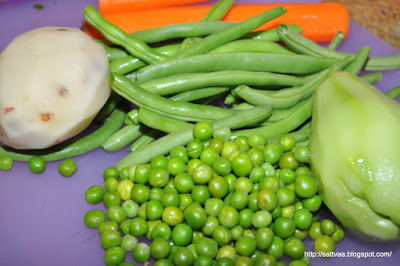
The most common vegetables are green beans, carrots, peas, potato, cauliflower and chayote squash. The criteria is two fold - the vegetables should hold their shape on cooking and should not impart any unnecessary flavor/smells in the dish. That means, those smelly stinky radish, cabbage, kohlrabi are out as are the slimy okra and eggplants :-). The amount of veggies is a personal preference, while some like more veggies and just enough gravy to connect them all, some prefer a few veggies floating in the flavorsome gravy. I like a balance, with both gravy and the bites. Nammamma never added cauliflower because it was not a vegetable she preferred to use :-). I have grown to like it and my family loves all things cauliflower, it goes well with the rest of the vegetable choices in this saagu. It doesn't change the saagu in anyway, so feel free to skip it if you don't have it handy. I didn't have it when I made it this time.
This gravy does not have the usual herbs(curry leaves & cilantro) used in the south indian cooking and there is no seasoning/tadka either. The flavoring agents are cinnamon, cloves and poppy seeds. Go ahead and try this super flavorful, creamy saagu for you next poorisession.

What do you need to make saagu?
2 cups of mixed vegetables (green beans, carrots, chayote squash, potatoes, green peas) - I used about 1/2 cup of each
1 Tsp chopped cilantro (optional for garnish)
1 Tsp salt (adjust to taste)
pinch of turmeric (optional, just to bring a little hue to the gravy)
To grind: 
1/2 cup coconut
1 inch piece of ginger
2 -1inch piece of cinnamon
4 cloves
1 Tbsp chopped onion
1 Tbsp gasagase/poppy seeds
1 Tbsp roasted gram/kadle
6 almonds (soaked in hot water and de-skinned) - This is my addition
4-5 green chilies (adjust to taste)

How do you make saagu? 
  • Clean and chop vegetables keeping the size and shape similar on all of them. 
  • Cook the vegetables in 1.5 cups of water until they are about half done but still crunchy (about 6-8 mins on med heat). 
  • Grind all ingredients listed under to grind with 1/4 cup of water to a smooth paste. 
  • Add the ground paste to the cooked vegetables along with salt and cook for about 10mins on low heat until well blended and starts to boil. 
  • Switch off the stove and add cilantro on top. Cover and let it rest.
Notes: 
  • Common saagu problem & correction: A good saagu has a creamy consistency and homogeneous texture. If the water is separating from the vegetables when you boil, the amount of thickening agents(coconut, roasted gram or almonds) is to be adjusted. You can grind another Tsp of roasted gram with a spoon of water and add to the gravy to thicken it. 
  • Vegetables need to have an opportunity to boil in the ground masala paste, cook them only half done before adding the paste and then continue cooking on low heat. 
  • Almonds do impart a rich taste to saagu, however take care not to over do the nuts as it tends to make the gravy texture very different from the Mysore saagu. Stick to the quantities given above for 4 servings of delicious saagu. 
  • There is no seasoning in this dish and it tastes awesome without it. 

Sunday, November 8, 2015

Badam Poori - A melt in the mouth, heavenly desert from Mysore for all celebrations

The other day I went to the public library after quite some time and just picked up a random book from the display. As with anything random in life, random books picked off the shelf can either make a great read filling you with warmth and contentment or leave you unsatisfied completely. This one fell somewhere in the middle - had a topic that would catch and sustain your attention and the story telling itself is good but the subject was too chilling for me to enjoy on a Saturday. It has been a while since I have found the time to sit and read books at a stretch, mostly it is a little bit every night and I have an assorted set of books on my bed stand from fiction to spiritual to DIY to cookery books all lining up there. Either I am multi tasking (pros and cons of this for another discussion ;-)) or pressed for time or really tired and ready to crash by the time I pick up the book, so it doesn't really go a long way.

This weekend, the weather wasn't conducive to any outdoor activities as it has been raining since Friday and BH was home sick with a stomach bug he caught. So, being cooped up at home with a husband who was mostly indulging in therapeutic sleep, left me with ample time to cuddle up with my book. 'The Hours really count' is an eerily chilling historical fiction related to the infamous Rosenberg couple who were subjected to death penalty in the 1950s for espionage. The writing is gripping and makes you not put the book down half way through (yes, I did a marathon and finished it at 1am last night) but it is not a subject I would recommend for a read on a cozy, rainy day, something more cheerful maybe.. Next time, I will spend some time before picking up a book for my reads :-). If you have some good reads, please go ahead and recommend.
Other than that, the weekend seemed to just fly by and we are almost at the point where I will start preparing our lunch boxes for tomorrow :-), well a few more hours anyway..

Indian festivals are countless really. If you enjoy celebrating festivals, every day on the Indian calendar can give a reason and excuse to do so :-).  Looking at it I feel that our ancestors truly embraced the concept that life itself is a celebration and everyday is an occasion to be thankful for. While I love the 'being thankful for' everything in life idea, due to practical constraints, I pick and choose the most significant festivals to celebrate. Here 'significance' only refers to what I have been exposed to from childhood and I what I can relate to even today. In India, festivals are both spiritual and cultural. The spiritual side of the celebration tends to be quiet and peaceful while the cultural angle emphasizes on sound, colors, and ofcourse food :-). Every Indian festival is laced with loads of food which I agree is the easiest way to have people participate willingly. The world of food blogging is no stranger to this concept and I really admire the effort of fellow bloggers that goes into cooking, clicking and blogging about the innumerable sweets and savory dishes for every festival. I personally don't make that many varieties every time so my contribution to the festival cooking craze is usually very light.
What I lack in numbers, I try to make up in quality. Badam poori is a typical Mysore sweet made during Dasara or Deepavali as it is easy to pack and distribute and extremely delicious. This used to be a childhood favorite at home and nammamma made them in bulk always. I am not sure why it is called badam (almond) poori when it actually doesn't have any almonds in it. I had asked nammamma about it long time back and her response was that the color of the fried poori should resemble peeled almonds (light golden). Not sure how far this is true but you have something to go on :-). This is succulent as the syrup not only is coated on the outer surface but the entire poori soaks up the sugar as it rests.

I actually made this sweet during Dasara a couple of weeks back, took a whole tray to my Balvihar classes,  sent a bunch to DD and took some to work. The resounding feedback from everyone who ate it was similar and positive. Though I missed posting it for Dasara, here it is in time for Deepavali (Festival of lights) coming up early next week.
This time when I went to India, I got a few real treasures from akka in the form of organic saffron powder and some edible camphor. I know these are not rare and you will get it if you go to the right shops in India. What made the gift from akka special was that the 2 tiny bottles I got are atleast 2 generations old (about 70+ years) and home made. As you can imagine, I use them both very carefully and with lot of respect. The saffron powder is so potent that a sprinkle will add lot of flavor and color to any dish. If you want to, use saffron strands soaked in a Tbsp of warm milk instead of the powder.
What do you need to make Badam Poori? 
Makes about 25 pieces 
1 cup All purpose flour
1 pinch baking soda
1 Tbsp ghee (clarified butter)
pinch saffron color
2 Tbsp yogurt
water to make a stiff dough
Sugar syrup: 
1 cup water
3/4 cup sugar
1/4 Tsp fresh cardamom powder
Others:
oil to deep fry
2-3 Tbsp grated kobbari (dry coconut or desiccated coconut)

How do you make Badam Poori? 

Preparing the dough for poori:
  • In a wide bowl, sieve all purpose flour and baking soda together so there are no lumps. 
  • Add saffron color and ghee and rub the flour with gentle fingers to incorporate the ghee. 
  • When the dry flour gets coated with ghee and becomes crumbly, add yogurt and mix together. 
  • Add water little by little to make a stiff dough (just like the regular poori dough). 
  • Knead for 3-4 minutes to get a smooth surface, cover and let it rest for atleast 30 minutes. 
Preparing sugar syrup: 
  • In a deep and wide sauce pan, heat the water until warm. 
  • Add sugar and mix, let it dissolve. 
  • Let the mixture boil for about 10-12 minutes or until the syrup thickens - there is no string consistency for this recipe. The recipe has to get slightly thicker so it coats well on the pooris. 
  • Add cardamom powder, lower the heat to minimum and keep it warm until ready to use. 
Making badam pooris: 
  • Take the rested dough and knead it a couple times. 
  • Pinch off small balls (marble sized) from the dough and shape them into roundels. 
  • Take a ball of dough and make a round roti using a rolling pin. 
  • Fold the roti in half and then into quarters (this is to get layers), press the edges together so they hold the shape without opening up. 
  • Gently roll out once to flatten it further. This is the size of your badam puri, adjust the dough ball to any desired size you want. I left them at single server/bite sizes.
  • Take a fork and poke gently on the surface of the pooris to prevent them from completely puffing up when dropped in oil. 
  • Heat oil on medium heat, test by dropping a small piece of dough into it. If the dough comes up sizzling then the oil is ready. 
  • Prepare as many pooris as your oil can hold - (KEEP a MOIST paper towel on the prepared pooris and also the remaining dough to prevent drying)
  • Slide the pooris one by one into the hot oil and let it cook until the underside is golden in color. 
  • Flip each of the pooris over and let the other side turn golden too.
  • Take the pooris out with a slotted spoon onto a paper tissue laden plate and let it rest for a couple of minutes. 
  • Now drop the pooris into the warm syrup, turning them over so they get an even layer of syrup all over. 
  • Take the sugar dipped pooris onto a plate and sprinkle some grated dry or desiccated coconut on top. 
  • Repeat the process for remaining dough. 
Notes: 
  • Make the pooris as thin as you can when you first roll out so the final product doesn't become too thick or bulky. 
  • Make sure yogurt used for the dough is not sour, this is to give the softness in texture and not to act as a leavening agent. 
  • Do not let the pooris sit in the syrup for more than 30-45 seconds. 
  • The syrup should be warm and not hot or cold. 
  • Badam poori tends to soak up the syrup as it cools down and becomes succulent. 
  • I find the water to sugar ratio is perfect for us, if you prefer a much sweeter version, use 1:1 for the syrup. 

Sunday, June 21, 2015

BaaLekaayi (Raw plantain) kofta curry - A Father's day menu to celebrate one of the best dads!

Before I go off on my rants, let me wish all the wonderful men out there that are fathers or play the role of father for little kids by being their mentors, teachers, guides or just by being there when needed. Happy Father's day! You make this planet half beautiful (ofcourse the other half belongs to all the mammas :-)). Now for the teaser - here is my Father's day menu and thali this year, reach out and enjoy! or make them in your own kitchens and devour :-)
In a span of three weeks (or has it been 4 already? ok I am not counting and you shouldn't be too :-)), we celebrated a graduation party, a wedding and a graduation ceremony, not for the same person but the same generation. All went well and all the kids are smiling their happy smiles. I am still riding the high tidings with all the globe trotting I have been doing and currently feel as if I do not belong to any time zone. Adding to the woes is the especially busy work and general pace of life, so I sleep when sleep comes to me, I wake up when my eyes open themselves voluntarily. Somehow magically, I have managed to be productive and even active at work since I came back last Monday.
As for the wedding, it was the first big occasion in the family that all of us siblings and spouses made it and we were all brimming and gleaming with joy :-). Though mostly in buses, trains and other forms of transport for the 10 days we stayed there, family around us made it feel like a festival. Got to meet the extended clan and catch up on years of gap. Met my friends from college who made it to one of the events just to meet up, thanks JV & M, it was so good to see you. And then there was food, galores of it from the jowar bhakri (Oh, our new girl into the family is from the region and we got to eat the favorite jowar bhakri) and obbattu to the typical Mysore BBB (Bisi Bele BHath) and Jilebi (Jalebi). My heart is content and tummy satiated for a while now (also I need to go on diet :-))
I am still not into full fledged cooking at home, letting amma take care of the kitchen. But as we hit the weekend, the responsibility genie kicked in and I went grocery shopping as usual on Friday. Bought a bunch of veggies to replenish the anemic refrigerator. On saturday morning when I asked the BH what I should be making for lunch/brunch, the response was, "Oh don't get stuck in the kitchen, get some sleep. Just make some poori, chole, maagayi and we will be good :-)". He of the generous heart! My family jumps at the mention of pooris and since DD has been all relaxed since her graduation (infact, she is almost on the brink of boredom already having exhausted her sleep induced by jetlag and deprivation), I decided to make pooris for lunch. Instead of chole, I made saagu to give some veggie boost to the oily monster and we ate so heavily in the afternoon, nobody felt the need for dinner.
Before I knew, it was already Sunday and Father's day too! Currently with two fathers at home, both of them big time foodies, I wanted to make something they would enjoy for lunch. I looked at the vegetables and saw 4 nice raw plantains I had bought on Friday already starting to don on a tinge of yellow after sitting on the counter for 2 days. Ok, I can see some of you starting to get up, stretch and yawn already thinking, "Didn't she put a plantain recipe recently and also talk about how much she loves the vegetable?", so I will be a good citizen and spare you the details of my love story with the vegetable. If you are a patient reader and still here, I promise I won't disappoint you, here is a keeper recipe for a side dish especially if you are bored of the spuds in all koftas and looking for potato alternatives. This is not a creative recipe from my kitchen, koftas and kofta curries are the rich gravies from Northern India and raw plantain or Kache kele ki kofte is a popular dish in UP and Bihar. But I will certainly claim the stroke of brilliance I had today with addition of fresh mint to koftas and strongly urge you to try this recipe my way.
The fathers were both bowled over by this kofta curry, so did DD and amma. With a crisp outer covering and melt in the mouth insides dunked in a sweet & spicy sauce, its vibrant color, this dish is a sure party pleaser if you want to make them. I also went the high calorie version today just to celebrate father's day by deep frying the koftas which gave a special texture to the koftas and made them completely irresistable. The only trouble with this recipe is that you will have a tough time saving the koftas for the gravy as they come out of the hot oil. They taste so delicious just like that, the family had no control over the temptation. I am glad I used all 4 plantains, so I had just enough koftas for lunch. So plan well if your family is like mine :-)
What do you need to make BaaLekaayi kofta curry? 
For Koftas: (about 12 lime sized koftas)
2 large baaLekaayi (raw plantain)
2 Tbsp finely chopped onion
2 Tbsp finely chopped fresh mint
2 green chilies - finely chopped
1 Tbsp finely chopped cilantro
1/2 Tsp red chili powder
1 heaped Tbsp besan (gram flour)
1 Tsp salt (adjust to taste)
For Gravy: 
5 cashews, 5 almonds
1 big onion chopped (about 1 cup)
2-3 big tomatoes chopped (about 2-2.5 cups)
1 inch fresh ginger - chopped
2 Tbsp milk (I used 2%)
1 Tsp salt (adjust to taste)
1 Tsp red chili powder (adjust to suit your spice tolerance)
1/4 Tsp amchoor powder (dry mango powder)
1/2 Tsp garam masala powder
1 Tsp kasoori methi (dry fenugreek)
2 Tbsp oil
Others: 
Oil to deep fry koftas (see low calorie version in notes)

How do you make BaaLekaayi kofta curry? 
Kofta Preparation: 
  • Wash the raw plantain, chop and remove the ends and cut each plantain into 2 or 3 pieces. 
  • Take a sauce pan with water and a pinch of salt, immerse all the plantain pieces and bring it to boil. 
  • Lower heat and cook for 6-8 minutes until the pieces are soft (make sure they are not breaking apart but just soft). 
  • Switch off, drain the water through a sieve and let the pieces cool down slightly. 
  • Heat a pan and dry roast the besan (gram flour) for 4-5 minutes, continuously stirring so it doesn't get burnt. 
  • When the besan starts to give out a nice nutty aroma, switch off and keep aside. 
  • Once the plantain pieces are cool to touch, peel them (it easily peels off and you won't need to fight :-)) and grate them with a grater, use the big holes side. 
  • Mix all the remaining ingredients for kofta with grated plantain in a bowl and using your fingers, bring them together into a mass. 
  • Taste and adjust spices or salt as needed. 
  • Make lime sized balls out of the mixture and keep ready. 
  • If you are deep frying the koftas, heat oil to deep fry. Test the readiness by putting a small piece of the kofta mixture, if it sizzles up to the surface immediately, you are ready to go. 
  • Drop the prepared balls one by one into the oil, do not pile them on top of each other, do it in batches. 
  • Reduce heat to medium high and let the koftas cook for a minutes before turning them over to the other side. 
  • Cook them until they are uniformly golden brown all over. 
  • Take them out of oil onto a paper towel. Repeat for all remaining koftas. 
Gravy Preparation: 
  • Heat a big pan with 1 Tbsp oil, add the cashew and almonds. 
  • Roast them for a minute and add chopped onions. 
  • Add salt and saute for a couple of minutes before adding chopped tomatoes and ginger. 
  • Cover and let cook for 4-6 minutes until onion and tomatoes soften. 
  • Switch off and let cool. 
  • Once cool, grind the mixture into a very smooth paste.
  • Heat the pan, add the ground mixture and 1/2 cup water. 
  • Let it cook and boil for about 10 minutes, the raw smell goes away and the sauce thickens slightly. 
  • Add red chili powder and amchoor powder at this stage and mix. 
  • Add milk and let it come to a boil. 
  • Finally add garam masala powder and crushed kasoori methi, mix and switch off. 
Serving: 
  • Heat the gravy separately if it has cooled down, pour it over the koftas a couple minutes before serving. 
Notes: 
  • It is important to not cook the plantain too much, it becomes a mush and takes more besan to hold shape which will change the taste. 
  • Let the cooked plantain cool and drain water completely before grating it. 
  • I roasted the besan as I like the enhanced nutty aroma, you can use it directly if you like. 
  • Adding mint really adds to the flavor of this dish, I would recommend not skipping it. 
  • You can make modifications to the gravy per your choice but I like this delicate, creamy sauce where the focus is just onions & tomatoes. 
Low calorie changes: 
  • Use aibleskiever(appe) pan to roast the koftas instead of deep frying them. This takes much less oil. You won't get the same crisp finish on the koftas as deep fried ones but when dunked in the sauce they anyway soften up. 

Sunday, April 26, 2015

Avalakki payasa (or pongal?) - kheer made with flattened rice

I made this avalakki payasa yesterday for a celebration and was about to write the post when I caught up with the news and saw the devastation in Nepal. Totally lost my taste for the sweet payasa and got up to do something to distract my mind. All my prayers to the people affected by this wrath of nature, hope us humans are able to stand support and help them rebuild their lives.

After a day of deliberation, I figured I would write this post anyways because it is special for more than one reason. First, it was my father's favorite payasa (or rather his favorite deity's favorite dish :-)). This is a popular offering from the Udupi math, very simple to make, extremely delicious and homely, at the same time perfect fit for any occasion. Second reason being that we were indeed celebrating a milestone yesterday. The baby is ready to fly the nest and experience life without her parents by her side, this is a bitter sweet moment for us as parents and as proud as we are of our little bundle of joy that has grown up into a fine young woman ready to move out of the safety net of home, we are at the same time trying to choke back the heavy feeling in the throat. Can't imagine coming back home in the evenings that would be devoid of the chirpiness characteristic of our little girl, or getting to work without that warm arms around the neck wishing a Good Morning and everything in between. But that is another 3 months away and I won't think about it until then as there is lots to do between now and then :-)
DD finalized her college choice yesterday and is excited about beginning a new life on campus while we are torn between feeling elated and anxious at the same time. I have been thinking of my father and wishing he was with us still to share the joy and also offer those ever ready shoulders of his when I needed to lean on and anchor myself. I have never spoken of my father except in passing on this blog, even after all these years (time doesn't fill certain voids in life) it is not easy for me to talk about what he meant to me and the rest of his children. He would have been one proud & supportive grandpa for all his grand children cheering them on at every one of their achievements and offering the best practical advice when they needed some.

Avalakki payasa is a thicker form of payasa or kheer made especially on Janmashtami or Krishnashtami as avalakki is known for its popularity with the Lord Krishna. I make this any time we feel like eating a quick sweet since it hardly takes time. Given avalakki's innate thickening quality, this payasa tends to resemble the sweet pongal rather than a flowy payasa :-). You don't have any lentil and so it doesn't officially quality for being called a pongal. If you really didn't care about the name, then this is a perfect cup of dessert to dig into as part of any celebration - big or small.
I love sweets with jaggery more than white sugar. You can substitute jaggery in this recipe with white sugar if you prefer, that retains a bright white color in the payasa. I add ground coconut (ground to a fine paste almost resembling thick coconut milk), you can use coconut milk instead or make it with regular milk.

So here is my humble avalakki payasa as we get go through a happy life changing event. Being a weekend, I made poori, saagu and green apple tokku for brunch and we ate our avalakki payasa to finish off a perfectly sleep inducing brunch :-).

Note: If you notice the color or hint of saffron strands in a couple of pictures and wonder why I didn't call out that ingredient in the list, please note that it is not an essential ingredient. BH was helping me out in the kitchen on this said morning and he loves to open my cupboards and pantry and keep adding stuff into the pots and pans on the stove :-). Adding saffron was one of his experimentation (nammamma would feel very proud of the SIL since she loves to sprinkle the expensive saffron into most of the sweets too :-)). I don't discourage you from adding saffron but it is not needed.
What do you need to make Avalakki payasa? 
1 cup avalakki/poha/flattened rice (use the medium variety)
3/4 - 1 cup jaggery powdered (based on your preference for sweetness)
2 cups milk
1 cup grated coconut
2 green cardamom
2 cloves
1 Tsp ghee (clarified butter)
1 Tsp raisins
1 Tsp cashews
How do you make Avalakki payasa? 
  • Take a heavy bottom pan and heat it to warm up. 
  • Pick any dirt from avalakki and pour it into the pan.
  • Roast it for 2-3 minutes until it crisps up slightly and loses the raw smell. 
  • Take it out onto a plate. 
  • Add jaggery pieces/powder to the pan along with 2 Tbsp water and let it dissolve.
  • Jaggery starts to bubble up once it mixes with water, at this stage add the roasted avalakki and mix it in. 
  • Make a smooth paste of coconut, cardamom and cloves with 1/2 cup milk in a blender. 
  • Let avalakki cook in the jaggery syrup for 5 minutes or until it becomes soft. 
  • Add the coconut paste at this stage along with the remaining milk. 
  • Mix and let it come to a good boil on medium heat. Take off heat. 
  • Heat ghee in a small pan, add raisins and cashews and roast until raisins plump up and cashes turn golden brown. 
  • Add this to the payasa and give a mix. 
  • Serve it warm or cold. 
Notes: 
  • You can use thin or paper avalakki in which case just rinse it under water and add it to the melted jaggery. 
  • If you are using white sugar instead of jaggery, bring 1/2 cup milk to boil, add sugar and let it dissolve. Continue with the rest of the process as above.